Reduction of Airflow Pulsation (reciprocating compressor) : Buffer Tank Solution
Buffer tanks are still widely used to this day due to their excellent effect in suppressing airflow pulsation.
Install the buffer tank at the compressor cylinder (vibration source) and isolate it from the pipeline. Its function is that the pulsating airflow is reduced in the buffer tank, and the pulsation in the pipeline becomes mild. The buffer tank can change the natural frequency of the gas column in the pipeline system, significantly increasing the natural frequency value of the gas column between the cylinder and the buffer, thereby avoiding low-order gas column resonance. When the buffer tank is large enough, it acts like a reservoir, playing a role in stabilizing pressure. The buffer tank is also a low-pass filter that has a strong attenuation effect on high-frequency waves.
There are various methods to determine the volume of a slow charging tank, and the degree of simplicity varies greatly. The volume of the buffer tanks currently in use is mostly 10 to 15 times that of the working volume of the cylinder. The farther the slow charging tank is from the cylinder, the larger the volume required. In some cases, the volume can even reach 25 to 40 times the working volume of the cylinder.
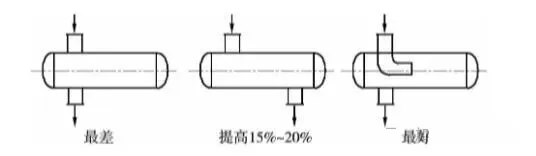
The closer the buffer tank is installed to the cylinder, the better its buffering effect will be. When the installation space permits, the buffer tank should be directly connected to the flanges of the cylinder's intake and exhaust ports as much as possible. The influence of the inlet position of the buffer tank on the buffering effect is also quite obvious. As shown in the figure, the buffering effect of Scheme I is not obvious. The buffering effect of Scheme II can be improved by 15% to 20%. The effect of Plan Ⅲ is 2 to 3 times higher than that of Plan Ⅰ. In addition, installing the buffer tank horizontally is more effective than installing it vertically.
Domestic scholars have conducted relevant experiments and reached the following conclusions:
(1) As the volume of the buffer tank increases, the pressure pulsation value in the pipeline gradually decreases, thus confirming the fact that increasing the volume of the buffer tank can effectively reduce the airflow pulsation in the pipeline.
(2) As the length of the pipeline between the compressor cylinder and the buffer tank increases, the pressure pulsation of the airflow inside the pipeline gradually increases.
(3) When it is necessary to increase the volume of the buffer tank, increasing the volume of the buffer tank by increasing its diameter is more effective in reducing the pulsating pressure of the airflow in the pipeline than increasing its length. When the length-to-diameter ratio (length/diameter) of the buffer tank is between 1.5 and 2.0, the buffer tank has the best vibration damping effect on the pressure pulsation within the pipeline system.
(4) Besides the volume of the buffer tank, the parameters of the connecting pipe between the compressor cylinder and the buffer tank also have a significant impact on the pressure pulsation of the airflow in the pipeline. When the length-to-diameter ratio (length/inner diameter) of the connecting pipe is between 1.25 and 1.75, the volume of the connecting pipe can better reduce the airflow pulsation in the compressor pipeline system. Moreover, when the length-to-diameter ratio of the connecting pipe is greater than 2.5, the pressure pulsation value in the pipeline gradually increases.
Buffer tanks come in two forms: cylindrical and spherical. When the volumes are the same, the buffering effect of spherical buffer tanks is better than that of cylindrical ones. Whether from the perspective of the force on the container or the reduction of air flow pulsation, spherical tanks are more superior for the high-pressure stage.