Explanations of various terms related to pressure gauges
-
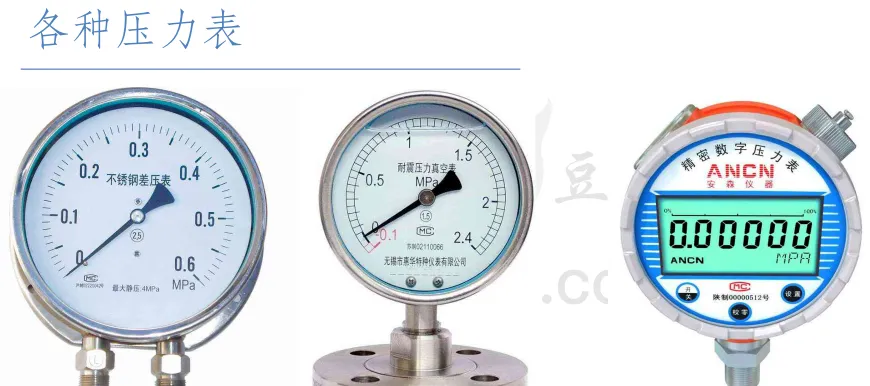
Pressure gauge: An instrument that measures pressure less than or greater than atmospheric pressure based on atmospheric pressure.
-
Pressure: In fact, it refers to the physical pressure intensity, that is, the magnitude of the pressure exerted per unit area.
-
Absolute pressure: The pressure above the absolute pressure zero position based on the absolute pressure zero position.
-
Positive pressure: Pressure that is higher than atmospheric pressure based on atmospheric pressure.
-
Negative pressure (vacuum): Pressure that is lower than atmospheric pressure based on atmospheric pressure.
-
Differential pressure: The difference between two pressures.
-
Gauge pressure: The pressure that is greater or less than atmospheric pressure with atmospheric pressure as the reference.
Within the measurement range, the indication error should not exceed the specified allowable error.
Within the measurement range, the return error should not exceed the absolute value of the specified allowable error.
3. Tap the displacement gently
After gently tapping the case, the variation of the pointer reading should not exceed half of the absolute value of the specified allowable error.
4. Stability of pointer deflection
Within the measurement range, the pointer deflection should be smooth without any jumping or jamming.
Introduction to the accuracy grades of pressure gauges
The accuracy grade of pressure gauges is the abbreviation of the precision grade or accuracy grade of pressure gauges. The applicable standards include
GB/T1226-2001 "General Pressure Gauges", and JJG52-1999 "Spring Tube General Pressure Gauges, Pressure Vacuum Gauges and Vacuum Gauges".
The accuracy grade of a pressure gauge is expressed as the percentage of the allowable error to the gauge's range, and is generally divided into
There are seven grades: 0.5, 1, 1.5, 2, 2.5, 3, and 4 (grade 3 and grade 4 are not used on boilers). The smaller the value, the higher the precision. For instance, for a pressure gauge with a dial range of 0 to 2.5MPa and an accuracy of 2.5 grade, the allowable error between the pressure value indicated by its pointer and the actual pressure value of the measured medium shall not exceed 2.5MPax2.5%=±0.0625 MPa: when the pressure indicated by the pressure gauge is 0.8MPa, The actual gas pressure is between 0.7375 and 0.862 mpa.
It can be seen from this that the actual error of a pressure gauge is not only related to its accuracy but also to the range of the pressure gauge.
When the range is the same, the higher the accuracy (i.e., the smaller the number), the smaller the allowable error of the pressure gauge. When the accuracy is the same, the larger the range, the greater the error of the pressure gauge.
Nominal diameter of the housing (mm, accuracy grade)
"40; 60 2.5; 4.0
10 1.6; 2.5
"150; 200; 250 1.0; 1.6
Note: The allowable error of the 1.5-grade pressure gauge in use is calculated as 1.6-grade, and the accuracy grade does not need to be changed.
The representation methods and classification of pressure
There are two ways to express pressure: one is the pressure expressed with absolute vacuum as the reference, which is called absolute pressure; Another type is the pressure expressed based on atmospheric pressure, which is called relative pressure. Since the pressure measured by most pressure measuring instruments is relative pressure, relative pressure is also called gauge pressure. When the absolute pressure is less than the atmospheric pressure, it can be expressed by the value of the absolute pressure inside the container being less than one atmosphere. It is called "vacuum degree". Their relationship is as follows:
Absolute pressure = atmospheric pressure + relative pressure
Vacuum degree = atmospheric clamping force - absolute bed force
The legal unit of pressure in China is Pa(N/ m ²), known as PASCAL or simply Pa. Because this unit is too small, its 10^6 times unit, MPa(megapascal), is often used.
Pressure gauges can be classified into precision pressure gauges and general pressure gauges according to their measurement accuracy. The measurement accuracy grades of precision pressure gauges are 0.1, 0.16, 0.25 and 0.4 respectively; while those of general pressure gauges are 1.0, 1.6, 2.5 and 4.0 respectively.
Pressure gauges can be classified in many ways based on the reference of the indicated pressure:
According to the measurement accuracy of pressure gauges, they can be classified into precision pressure gauges (GB/T1227) and general pressure gauges (GB/T1226).
2. According to the different references of pressure, pressure gauges are classified into general pressure gauges, absolute pressure gauges and differential pressure gauges.
3. According to the measurement range of pressure gauges, they are classified into vacuum gauges, pressure-vacuum gauges, micro-pressure gauges, low-pressure gauges, medium-pressure gauges and high-pressure gauges.
4. According to the composition of pressure gauges, they can be classified into liquid column type, electronic type and mechanical type.
The structure and working principle of pressure gauges
The open-type spring tube pressure gauge is composed of five main parts: the case part, the pointer, the dial part, the spring tube, the transmission mechanism part and the tube joint. When the spring tube is subjected to the pressure of the medium, its movable end extends outward, driving the pointer to rotate through the transmission mechanism, and the pressure of the medium is indicated on the dial
The sealed spring pressure gauge is also composed of six main parts: the casing, the pointer, the dial, the spring tube, the elbow tube and the transmission chamber mechanism. The inner cavity of the spring tube is in a closed form. The external pressure acts on the outside of the spring tube, causing it to deform. The transmission mechanism drives the pointer to rotate and indicate the ambient pressure.
The number in amperes within the circle below the pressure gauge dial marks the accuracy grade of the pressure gauge. It indicates that the basic error of this table does not exceed the percentage of the full scale. The smaller the number, the higher the precision.
The pressure value within the measurement range is displayed by the pointer, and the indication range of the dial is generally made to be 270 degrees.
Installation and setup of pressure gauges
(1) It should be placed in a location that is convenient for observation and cleaning, and should avoid being affected by adverse factors such as radiant heat, freezing or vibration.
(2) The pressure gauge should be installed vertically. When installed at a higher position, it can be slightly tilted forward for easier observation, but the tilt Angle must not exceed 30 degrees.
(3) In some cases, a buffer elbow pipe should be installed before the pressure gauge to prevent compressed air from directly entering the spring elbow pipe and to avoid the accumulation of condensate water.
(4) A three-way cock or needle valve should be installed between the pressure gauge and the buffer elbow to facilitate the replacement and calibration of the pressure gauge.
Precautions for the selection and use of pressure gauges
Pressure gauges are common measuring instruments and are widely used in various fields. It can visually display the pressure changes in each process link, perceive the formation of conditions in the product or medium flow, monitor the safety trends during the production operation process, and through automatic interlocking or sensing devices, build a rapid and reliable safety guarantee, playing an important role in preventing accidents and ensuring personal and property safety. It is called the "eye" of safety.
The maximum range (the limit value of the scale on the dial) of the pressure gauge installed on the boiler or pressure vessel should be adapted to the working pressure of the equipment. The range of a pressure gauge is generally 1.5 to 3 times the working pressure of the equipment, and it is best to take 2 times. If the range of the selected pressure gauge is too large, for pressure gauges of the same precision, the larger the range, the greater the absolute value of the allowable error and the deviation observed by the naked eye, which will affect the accuracy of the pressure reading. Conversely, if the selected pressure. If the range of the gauge is too small and the working pressure of the equipment is equal to or close to the scale limit of the pressure gauge, the elastic element in the pressure gauge will be in the maximum deformation state for a long time, which is prone to permanent deformation, causing an increase in the error of the pressure gauge and a reduction in its service life. In addition, if the range of the pressure gauge is too small, and it operates under overpressure, the pointer will exceed the maximum range and approach zero, causing the operator to have a false impression and leading to a more serious accident. Therefore, the operating pressure range of the pressure gauge should not exceed 60% to 70% of the scale limit.
Common pressure units and conversions
-
PASCAL (N/m ²); Kilogram force per square centimeter Kgf/cm ²; ";bar;"
-
Millibar (mbar) Standard atmospheric pressure atm "torr;" Inch water column inH2O:
-
Millimeter mercury (mmHg) Pounds per square inch PSI(lb/in ²)
-
1Mpa≈10Kg/cm 1Bar1Kq/cm
-
1Mpa=1000Kpa 1Bar=100Kpa
-
1Mpa=10000mBar 1Bar=1000mBar
-
1Mpa=7500mmHg 1Bar=750mmHg
-
For ease of memory, it can be simplified to the following rule:
-
1atm=0.1MPa=100 kpa =1 kilogram =1bar=10 meters of water column =14.5PSI
-
1KPa=0.01 kilograms =0.01bar
10 mbar = = = 0.3 inHg = 7.5 7.5 mmHg torr
=100mmH2O=4inH2O
Spring tube pressure gauge and installation points
At present, the most widely used local pressure gauge in production sites is the mechanical pressure gauge. Mechanical pressure gauges are mainly classified into spring tube (Bourdon tube) pressure gauges, diaphragm pressure gauges, diaphragm box pressure gauges and bellows pressure gauges according to the difference of their elastic sensitive elements. This article mainly takes the spring tube pressure gauge as an example.
Spring tube pressure gauges come in a wide variety of types and specifications. They feature a simple structure, ease of use, high precision, durability and low cost. Therefore, they are widely used in various pressure measurement scenarios in industrial production. Spring tube pressure gauges, also known as corrugated tube pressure gauges, are classified into types such as C-tube, coil spring tube, and spiral tube. Its structure is shown in the figure.
Structural diagram of the spring tube pressure gauge
The elastic deformation of the spring tube under the action of the medium pressure in the inner cavity, by taking advantage of its elastic characteristics, converts the pressure into the elastic displacement of the free end of the spring tube, and then amplifies it through the gear transmission mechanism of the pressure gauge. The pressure gauge will then display the relative value (either higher or lower) relative to the atmospheric pressure. The pressure value within the measurement range is indicated by the pointer. The measurement range of the spring tube is generally between 0.1MPa and 250MPa.
The following points should be noted when installing pressure gauges:
The installation position of the pressure source component should be selected at a place where the medium flow rate is stable.
When measuring the pressure of turbid media containing dust, solid particles or sediment, the source component should be installed at an upward tilt.
3. When the pressure source components are installed on horizontal and inclined process pipelines, the position of the pressure tapping port shall comply with the following provisions:
(1) When measuring gas pressure, do it at the upper half of the process pipeline.
(2) When measuring liquid pressure, within the range where the lower half of the process pipeline forms an Angle of 0 to 45 degrees with the horizontal centerline of the process pipeline.
(3) When measuring steam pressure, within the range where the upper and lower halves of the process pipeline form an Angle of 0 to 45 degrees with the horizontal centerline of the process pipeline.
Pressure gauge verification cycle
Pressure gauges are divided into mandatory verification and non-mandatory verification. Not all pressure gauges are subject to mandatory verification. In 2019, the State Administration for Market Regulation issued the "Announcement on the Catalogue of Measuring Instruments Subject to Compulsory Administration" (Announcement No. 48 of 2019). According to the catalogue, items 21 and 22 of pressure gauges used for safety protection are subject to compulsory inspection, as shown in the figure

Pressure gauges that require mandatory inspection
For non-mandatory verification type pressure gauges, regular verification is also required, but the verification cycle is determined by the enterprise itself.
On October 10, 1988, the Ministry of Chemical Industry and the State Bureau of Technical Supervision jointly issued the "Interim Measures for the Grading Management of Measuring Instruments in the Chemical Industry", which classified measuring instruments into three levels: A, B, and C for management in chemical enterprises. According to the "Catalogue of Grading Management of Measuring Instruments in Chemical Production Enterprises" in the appendix of this method, the grading and verification cycle of pressure gauges in chemical enterprises are as follows:
Grade A: Pressure gauges used for safety protection should be calibrated at least once every six months.
Grade B: Pressure gauges used for process control, with a verification cycle of the maintenance period of the equipment.
Grade C: Pressure gauges used for monitoring, with a verification cycle of 1 to 2 years; The pressure gauge for monitoring does not require periodic verification. It should be replaced once a fault occurs.
Pressure gauges are indeed important, but they are not omnipotent. Relying solely on the pressure indicated by the pressure gauge to determine the pressure of equipment, pipelines, etc., is not reliable. On September 17, 2023, the accident at Yiding Ecological Agriculture Development Co., Ltd. in Ordos City, which resulted in 10 deaths and 3 injuries, is a typical case of an accident. This accident also reminds us that we need to strengthen the daily maintenance and regular inspection of monitoring and measuring instruments such as pressure, liquid level and temperature to ensure their good condition and usability. This is also one of the important aspects of equipment integrity.