Thermodynamic research on Natural Gas/Hydrogen Fuel compressed air Energy Storage Systems at Xi 'an Jiaotong University
Technical field: Compressed air energy storage
Developer: Zhao Pan, Xi 'an Jiaotong University
Article Title Ning Ma, Pan Zhao et al. Thermodynamic analysis of natural gas/hydrogen-fueled compressed air energy storage system, International Journal of Hydrogen Energy 2024.
Technological breakthrough: Research has found that by increasing the hydrogen mixing ratio from 0.5 to 1, the round-trip efficiency, turbidity efficiency and energy density of the system can be significantly improved, increasing by approximately 1.08%, 3.88% and 1.24% respectively.
Application value: It provides a theoretical basis for the design and optimization of CAES systems, which is conducive to promoting the development of energy storage technologies, especially in the integration of renewable energy into the grid and large-scale application in power grids.
In recent years, the global demand for reducing fossil energy consumption and lowering greenhouse gas emissions has been increasing day by day, making the development and utilization of renewable energy particularly important. In its "Renewables 2022" report, the International Energy Agency (IEA) predicts that the global installed capacity of renewable energy will increase by 2,400 gigawatts between 2022 and 2027, and it is expected that by 2040, renewable energy will account for 40% of global energy consumption. However, the volatility and intermittency of renewable energy sources such as wind and solar power pose challenges to grid security, especially when a high proportion of renewable energy is connected to the grid. Therefore, it has become crucial to develop energy storage technologies suitable for the grid connection of a high proportion of renewable energy. Compressed air energy storage (CAES), as a mechanical energy storage technology with long-term energy storage capabilities, and pumped storage (PHS) are the only two commercial technologies with long-term energy storage capabilities. Because it can establish gas storage rooms in abandoned mines, salt caverns or artificial air tanks, it is less restricted by geographical conditions compared with PHS technology. However, the existing commercial CAES technologies mainly rely on the combustion of fossil fuels to provide energy, which not only consumes fossil fuels but also generates carbon emissions.
To address this issue, a research team from Xi 'an Jiaotong University proposed a non-isothermal compressed air energy storage (D-CAES) system using a natural gas/hydrogen mixture as fuel, aiming to enhance the environmental friendliness and thermodynamic performance of the system. A comprehensive thermodynamic analysis of the system was conducted, and the layout diagram is shown in Figure 1. The research results show that increasing the hydrogen mixing ratio can significantly enhance the round-trip efficiency, turbidity efficiency and energy density of the system. When the hydrogen mixture ratio increased from 0.5 to 1, the round-trip efficiency increased by approximately 1.08%, the turbidity efficiency increased by approximately 3.88%, and the energy density increased by approximately 1.24%. In addition, they also found that the proportion of turbidity damage in the burner was the highest, and increasing the proportion of hydrogen mixture could significantly reduce turbidity damage. Through parameter analysis and sensitivity analysis, this study identified the key factors affecting system performance, including the burner outlet temperature and expansion ratio. The research results have significant reference value for designing sustainable CAES systems. This study also explored the performance changes of the system under different operating conditions with different hydrogen mixing ratios, providing a theoretical basis for the design and optimization of the CAES system. Overall, this research not only provides a new environmentally friendly solution for the development of CAES technology, but also holds significant importance for enhancing the performance of CAES systems and reducing their environmental impact. By using hydrogen as fuel, the D-CAES system is expected to become a cleaner and more efficient energy storage technology, which will help promote energy transition and achieve the goal of carbon neutrality. (Compiled by Wang Runze and Zhang Xinjing, INESA)
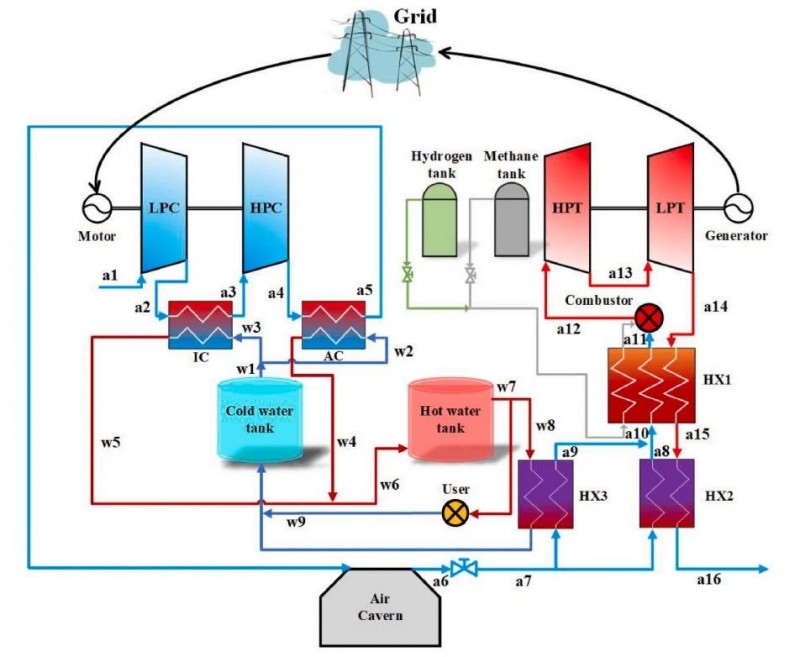
Figure 1 Layout diagram of the natural gas/hydrogen fuel CAES system
Source: International Energy Storage Technology and Industry Alliance